
The Science Behind HTMA: Understanding What Your Body Is Really Trying to Tell You

"Wait, you can tell all that from my hair?"
It's the question we hear most often. And honestly?
We get it.
How can a small sample of hair reveal what's happening deep inside your body? Doesn't hair just... regrow? How is this different from a blood test?
Great questions. Let's answer them.
Minerals are the root of vitality—they unlock your body's ability to heal, restore balance, and flourish naturally.
What is HTMA?
Hair Tissue Mineral Analysis
HTMA is a simple, non-invasive lab test that measures the mineral levels and toxic metal exposure in your body at the cellular level.
Here's how it works: You collect a small sample of hair from the scalp (about a tablespoon), send it to a lab, and within a couple of weeks, you receive a comprehensive report showing:
✓ 20 essential minerals your body needs to function
✓ Toxic metals like lead, mercury, aluminum, arsenic, and cadmium
✓ Mineral ratios that reveal how your cells are creating energy, managing stress, and maintaining balance
Unlike other tests that give you a quick snapshot of one moment in time, HTMA shows patterns over the past 2-3 months revealing what's been stored in your tissues and affecting your health from the inside out.
It's not invasive. It doesn't require needles or a doctor's visit. And it reveals what blood tests often miss.

Why Hair? Doesn't It Just Regrow?
Yes, hair regrows—and that's exactly what makes it so valuable.
Here's how it works: As your hair grows, minerals from your body's tissues are deposited into the hair shaft. Your body actually "pushes out" excess minerals and toxic metals into your hair as it forms. This means your hair becomes a permanent record of what's been circulating in your tissues over the past 2-3 months.
And here's the key: Even if you cut your hair off completely, the new hair that grows will contain a fresh record of what's currently happening in your body. The minerals don't disappear—they continue being deposited as long as your hair is growing.
This gives us a long-term view of your cellular health that other tests simply can't provide.
Here's how it compares to other tests:
Blood Tests: Show you what's in your bloodstream right now—a snapshot that changes based on what you ate today, how stressed you are, or whether you just took a supplement. Blood works hard to stay balanced, so imbalances don't always show up until things are seriously wrong.
Urine Tests: Show what your body is actively excreting—what it's getting rid of, not what it's storing or struggling with.
Hair Analysis: Captures what's been stored in your tissues over weeks and months. It reveals patterns and imbalances that blood and urine can't detect—often before symptoms even appear.
Think of it this way: Blood is a snapshot. Hair is a timeline.

The Science: It's Not About High or Low...
It's About Ratios
Here's what most people don't understand about minerals: they don't work alone.
You can have "normal" magnesium levels on a test, but if your calcium-to-magnesium ratio is off, you'll still experience symptoms—anxiety, poor sleep, blood sugar issues, muscle tension.
You might supplement with zinc to boost immunity, but if your zinc-to-copper ratio becomes imbalanced, you could end up with new problems: mood swings, fatigue, or weakened immune function.
This is why blindly supplementing doesn't work and often makes things worse.
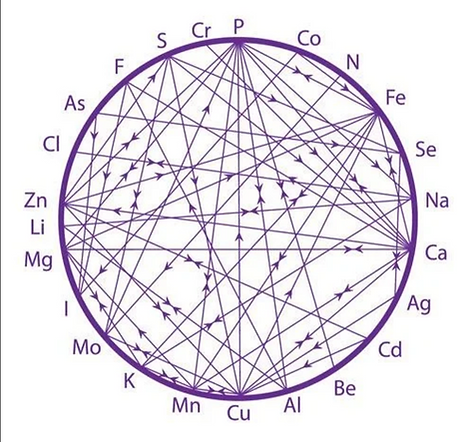
Minerals work in relationships. Some support each other (synergistic), while others compete (antagonistic). When you add one without understanding how it affects the others, you risk creating new imbalances while trying to fix the old ones.
Here's what matters most:
Calcium/Magnesium Ratio – Affects stress response, blood sugar balance, and nervous system function
Sodium/Potassium Ratio – Reveals inflammation levels, vitality, and how your body handles stress
Calcium/Potassium Ratio – Impacts thyroid function and metabolic rate
Zinc/Copper Ratio – Controls hormone balance, immune function, and emotional regulation
This framework was pioneered over 50 years ago by Dr. Paul Eck, a biochemist who spent decades studying how minerals interact within the body. His research revealed that balancing these mineral ratios—not just correcting individual deficiencies—is the key to restoring cellular health and optimal function.
This is why working with a certified HTMA practitioner is essential because interpreting the results—understanding the complex interplay of minerals and creating a personalized protocol that supports your body safely—requires training, experience, and precision.